




P2P crypto trading has a security problem that escrow alone cannot solve.
A standard escrow protects the digital asset while a buyer and seller complete a trade. It can confirm that the crypto remains locked until the seller acknowledges payment. What it cannot reliably establish is whether the person who sent the fiat is actually the person buying the crypto.
That gap is where a P2P crypto triangle scam begins.

The risk has become harder to ignore as crypto, bank transfers, and P2P payments increasingly overlap. The US Federal Trade Commission reported around $16 billion in fraud losses for 2025, up roughly 25% from 2024. Imposter scams alone accounted for $3.5 billion.
Crypto has its own exposure. FATF’s March 2026 report on stablecoins and unhosted wallets specifically identifies illicit-finance risks associated with stablecoin P2P transactions. By mid-2025, more than 250 stablecoins were in circulation, with a combined market capitalisation exceeding $300 billion.
For P2P platforms, exchanges, and merchants, crypto P2P fraud prevention therefore has to move deeper into the payment flow. Checking whether money arrived is no longer enough. Platforms need to know who sent it, which trade it belongs to, and whether the fiat leg matches the verified parties on the crypto side.
Understanding the rise of triangle scams in P2P crypto trading
A triangle scam links two legitimate transactions through a single fraudulent intermediary.
Consider a simple example:
A fraudster advertises a laptop online for £1,000. A genuine buyer agrees to purchase it. At the same time, the fraudster opens a P2P order to buy £1,000 worth of cryptocurrency from a legitimate crypto seller. Instead of giving the laptop buyer their own bank account details, the fraudster sends the P2P crypto seller’s bank account details.
The buyer transfers £1,000. The crypto seller sees the correct amount in their account and assumes their P2P counterparty has paid. They release the cryptocurrency from escrow.
The fraudster disappears with the crypto. The buyer never receives the laptop.
The problem surfaces later. The buyer reports the original purchase as fraud and the bank traces their money to the crypto seller. That seller may have followed the visible P2P process correctly and still end up dealing with a frozen account, an investigation, or a dispute.

SPAYZ.io has previously identified third-party payments as a central weakness exploited by triangle fraud. Its guidance recommends blocking unauthorised third-party payments rather than relying solely on traders to notice them manually.
How a P2P triangulation attack works
A conventional P2P transaction contains two matched legs:
- The fiat moves from Buyer A to Seller B.
- The crypto moves from Seller B to Buyer A.
A P2P attack based on triangulation breaks that symmetry. The crypto still moves between the registered platform users, but the fiat comes from Person C.
Technically, the payment may look perfectly healthy. The amount is correct. It reaches the expected account. It also arrives before the trade expires. The identity associated with the payment is incorrect.
This distinction matters because the fraud signal exists across systems. The crypto platform knows its users’ identities through know-your-customer checks. The bank or payment provider knows the sender of the fiat transfer. Escrow knows whether the crypto has been released.
Unless those records are compared, each component can appear legitimate in isolation.
The role of unsuspecting third parties and stolen accounts
The third party does not always have to be a victim buying a fake product.
Fraudsters can route payments through compromised accounts, money mules, or people manipulated through impersonation and investment scams. Europol’s recent cases show the scale at which crypto and conventional financial infrastructure can intersect: in December 2025, authorities dismantled a cryptocurrency fraud and money-laundering network that had moved more than €700 million.
The FTC data points in the same direction. In 2023, consumers reported greater combined losses through bank transfers and cryptocurrency than through all other payment methods combined.
That makes the fiat-to-crypto boundary particularly sensitive. For a P2P operator, the question behind payment verification should therefore be more specific: did the verified buyer send the money from an authorised account?
Why traditional escrow systems fail to catch triangle fraud
P2P crypto escrow protection remains useful. It reduces straightforward counterparty risk by preventing one side from taking the crypto before the agreed conditions have been met. But escrow controls the asset it holds. It usually doesn’t control the banking rail used for the fiat payment. That distinction creates a blind spot.
A fraudster does not need to break the escrow mechanism. They only need to convince the seller that an unrelated incoming bank transfer is payment for the P2P order.
Major exchanges already treat identity matching as a core control. Bybit requires P2P users to use accounts under their verified KYC names and states that third-party payments aren’t permitted unless approved and verified by the platform. Its payment setup also retrieves the user’s name directly from identity verification rather than allowing it to be changed manually.
OKX similarly requires the account holder name on a payment method to match the name verified on the user’s exchange account.
These rules point towards where peer-to-peer exchange security is heading: connecting payment identity with platform identity before assets are released.
Infrastructure-level solutions to protect P2P platforms
User warnings still matter. “Don’t accept third-party payments” is good advice. It is also a weak primary control for a platform processing thousands of trades.
Humans miss discrepancies. Names are transliterated differently, and a merchant may handle several payments at once. Fraudsters also deliberately create time pressure. In high-volume operations, a security rule that depends on every trader manually checking every transfer will eventually fail.
The next layer of P2P exchange infrastructure security needs to make those checks part of system behaviour.
Automated bank account name verification and KYC matching
The clearest control is name matching.
When a P2P user completes KYC, the platform already holds a verified identity. When the fiat transfer arrives, available bank or payment data can be checked against that identity before crypto is released.
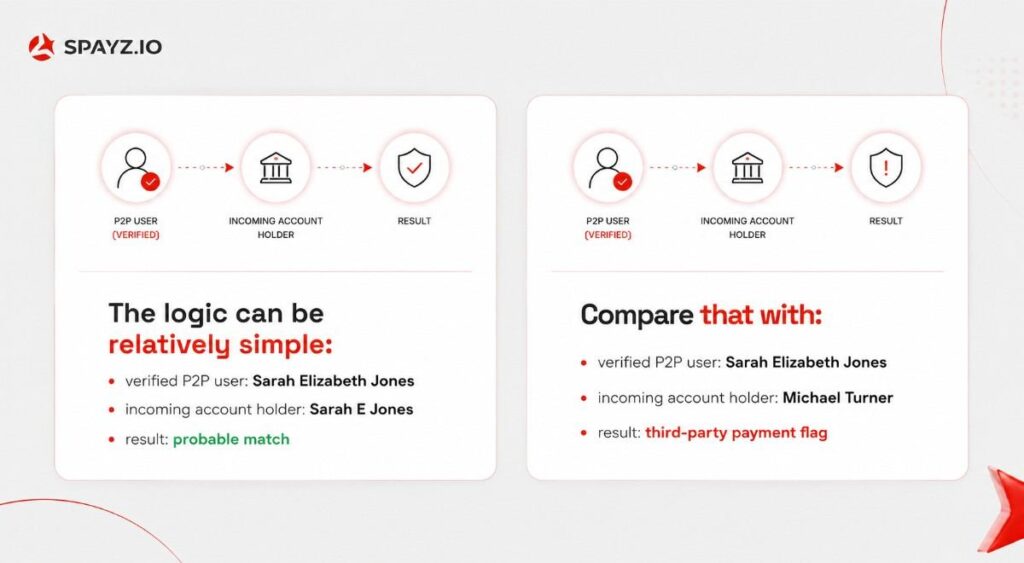
The logic can be relatively simple:
- verified P2P user: Sarah Elizabeth Jones
- incoming account holder: Sarah E Jones
- result: probable match
Compare that with:
- verified P2P user: Sarah Elizabeth Jones
- incoming account holder: Michael Turner
- result: third-party payment flag
Transliteration, middle names, joint accounts, business accounts, and different naming conventions across markets all need to be handled. A binary string comparison would create too many false positives.
The system therefore needs confidence thresholds and escalation rules. A high-confidence match can proceed normally. A partial match may require another check. A clear mismatch should stop automatic release and send the transaction for review. This is where preventing triangle fraud in P2P crypto stops being an educational message and becomes an infrastructure rule.
FATF’s standards follow the same broader principle. Virtual asset service providers are expected to conduct customer due diligence, keep records, and obtain originator and beneficiary information for transfers.
Advanced proof-of-payment and metadata tracking
Screenshots are weak evidence that can be edited, recycled from previous transfers, or taken from a legitimate transaction unrelated to the P2P order being reviewed. A better payment verification process works with transaction data wherever the local payment rail makes that possible.
Useful fields can include the payer name, receiving account, transfer amount, timestamp, payment reference, and bank transaction identifier. The platform can then compare that information with the active order. This becomes especially useful when several apparently minor anomalies occur together.
A new account submits a high-value trade. The sender name doesn’t fully match KYC. Payment arrives from an account that the trader has never used before, and the user then pressures the seller to release immediately.
None of those signals automatically proves fraud. But together, they justify friction.
For payment providers, that also means retaining a clean transaction record. SPAYZ.io’s P2P Agent Dashboard, for example, gives merchants a centralised registry for transaction monitoring, reconciliation, and agent management rather than leaving payment records scattered across chats and spreadsheets. The company’s wider infrastructure combines real-time monitoring with KYC/AML screening and fraud controls.
That operational history becomes useful when a suspicious trade needs to be reconstructed later.
Operational strategies for P2P merchants and platform operators
Infrastructure can catch a large part of the problem. It still needs sensible operating rules. The goal isn’t to hold every unusual transaction. If fraud prevention adds several hours to routine P2P trades, users will find another route. The useful approach is selective friction.
Implementing dynamic risk scoring and trade delays
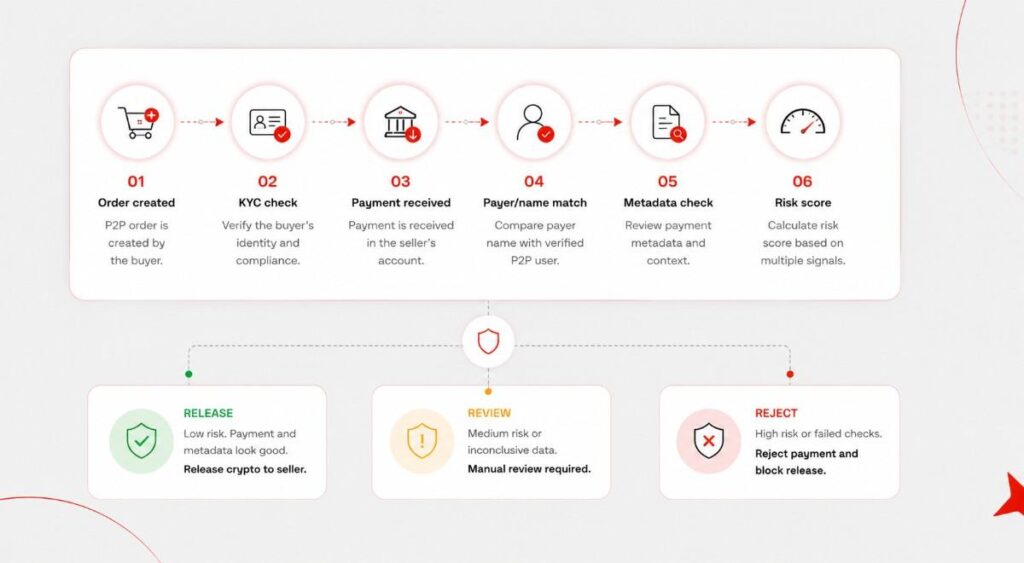
A P2P platform can assign risk before release using information already available during the trade.
Signals might include:
- KYC and payer-name mismatch
- a new bank account or payment method
- unusual changes in transaction value
- repeated failed or cancelled orders
- payments split across several accounts
- previous disputes linked to the user or payment account
- abnormal timing or behaviour during the trade
- sudden changes in device, location, or account access
Low-risk transactions continue normally. A trade crossing a defined threshold can trigger a short delay, a request for additional evidence, or a move to manual review. Higher-risk cases remain locked in escrow. That is much more precise than slowing the entire network because fraud exists somewhere inside it.
It also gives P2P merchant chargeback protection a stronger foundation. A merchant can show why a transaction was accepted, which identity checks were completed, and what evidence supported the release.
Building dispute resolution around evidence
A dispute should not begin with two users sending screenshots to customer support. The platform should already have most of the relevant information. That means keeping the P2P order ID connected to payment evidence, KYC records, timestamps, and release history. Where appropriate and legally permitted, device and behavioural data can add context.
With the order, payment, and verification data kept in a single record, the review team can trace who made the payment, whether the payer matched the verified user, and what happened before the crypto was released. This gives support a usable audit trail instead of forcing them to piece together a disputed transaction from screenshots and chat history.
P2P security is moving closer to the payment itself
The first generation of peer-to-peer exchange security focused heavily on custody: keep the crypto in escrow until the fiat payment arrives.
The next stage has to verify the fiat side with similar precision. That means connecting know-your-customer records with bank account ownership where data is available, rejecting unauthorised third-party payments, recording payment metadata, and applying additional checks before high-risk assets leave escrow.
The strongest crypto P2P fraud prevention model is therefore likely to be layered:
- Escrow protects the asset
- KYC identifies the platform user
- Name matching checks the payer
- Payment data establishes what happened on the fiat rail
- Risk scoring determines when a transaction requires additional scrutiny
A triangle scam depends on those layers failing to speak to each other. Make them speak to each other, and the attack becomes much harder to hide.
Disclaimer: This is an article written by SPAYZ.io, Fintechnews does not endorse and is not responsible for or liable for any content, accuracy, quality, advertising, products or other materials on this page. Readers should do their own research before taking any actions related to the company. Fintechnews is not responsible, directly or indirectly, for any damage or loss caused or alleged to be caused by or in connection with the use of or reliance on any content, goods or services mentioned in the article.
Please note this is no investment advice.
Featured image by on Magnific
