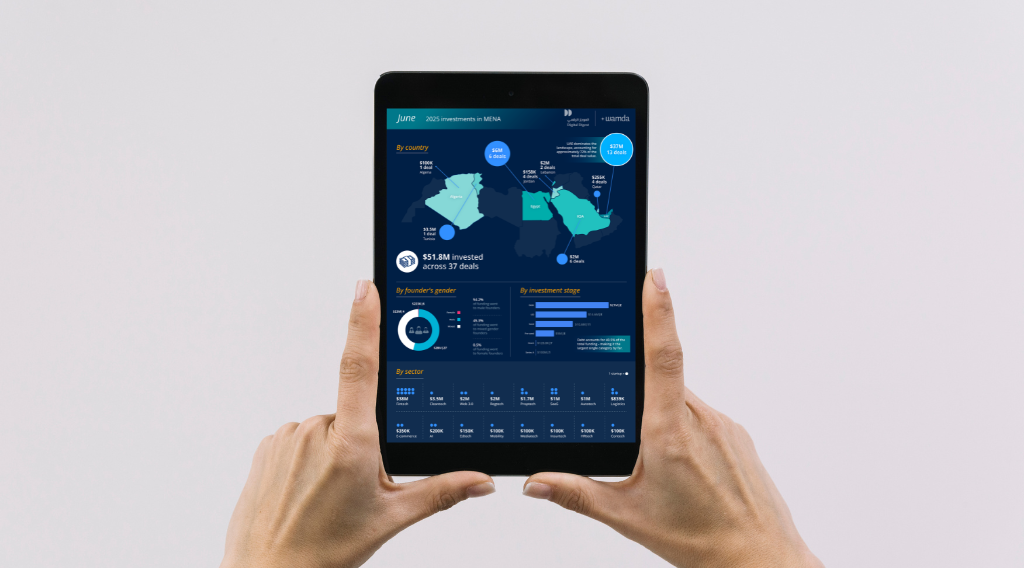


Startup funding across the MENA region dropped sharply in June 2025, with only US$52 million raised across 37 deals.
This marks an 82% decline compared to May and a 55% decrease year on year.
The downturn was further reflected by the fact that 40% of this capital came through debt instruments, suggesting increasingly cautious investor sentiment amid ongoing global economic uncertainty.

The UAE regained its position as the region’s top-funded market, with 13 startups raising US$37 million, accounting for more than 70% of the capital deployed during the month.
This represented a shift from May, when Egypt led the region.
Egypt came in second in June, raising US$6.2 million across six deals, according to Wamda.
Tunisia entered the top three for the first time, propelled by a single deal. Kumulus, a water generation startup, secured a US$3.5 million seed round.
This pushed Tunisia ahead of Saudi Arabia, where six startups raised a total of US$3 million.
The figure marked a significant drop for one of the region’s more active startup ecosystems.
Fintech remained the dominant sector, attracting 74% of the month’s total capital across ten deals.
Cleantech followed, thanks entirely to Kumulus, while the Web3 sector attracted US$2 million across two rounds.
Most of the funding, excluding debt-based deals, went to early-stage companies.
Seed-stage startups secured US$10.6 million across 11 rounds, followed by US$5 million in pre-seed funding distributed among eight transactions.
Only one Series A deal was recorded, valued at just US$100,000, highlighting a continued lack of growth-stage funding.
Startups with business-to-business models attracted the bulk of capital, receiving 78% of total funding across 21 deals.
Hybrid B2B2C models followed with US$9.7 million across five deals, while business-to-consumer startups raised under US$1.5 million across eight rounds, reflecting sustained investor interest in enterprise-oriented ventures.
In terms of gender representation, mixed-gender founding teams raised 45% of the total capital, though this was concentrated in only four deals.
Twenty-seven all-male teams secured US$28 million, while six women-led startups raised US$223,200.
Although the presence of mixed-gender teams is notable, the overall numbers underscore the persistent underrepresentation of female-led and mixed teams in the region’s funding landscape.
The figures from June represent one of the most significant monthly declines in startup funding for the first half of 2025.
The slowdown appears to be part of a broader recalibration of the MENA startup ecosystem, likely shaped by seasonal effects, valuation corrections, and constrained global liquidity.

