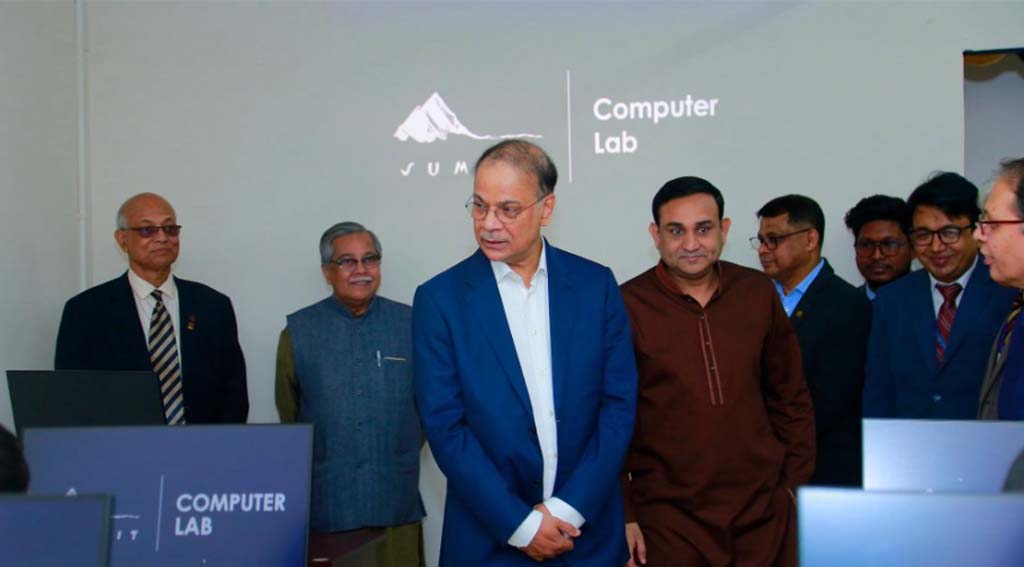




When Muhammed Aziz Khan established his first trading company in 1973, Bangladesh had been independent for less than two years.
The nation’s infrastructure remained largely undeveloped, and private sector involvement in critical industries like power generation was nonexistent. More than five decades later, Khan has built Summit Group into Bangladesh’s largest independent power producer, having built an infrastructure conglomerate that spans electricity generation, telecommunications, ports, and liquefied natural gas operations.
“Bangladesh was newly born and there were no entrepreneurs,”
Khan says.

“So I found a niche and I started the business.”
Khan, now 71, recently completed a planned leadership transition within Summit Group, elevating his brothers to chairman roles across key subsidiaries while maintaining his position as founder chairman of the overall group. This transition marks a new chapter for the conglomerate that Khan built from identifying early opportunities in Bangladesh’s emerging economy.
From Trading to Infrastructure
What began as a trading operation has evolved into a diversified infrastructure giant spanning power generation, telecommunications, ports, and logistics. Summit Power International now owns and operates 14 power plants with total capacity of 2,070 MW, making it Bangladesh’s leading independent power producer and reflecting 18.05% of Bangladesh’s total private installed capacity. The company also operates Bangladesh’s second floating storage and regasification unit for liquefied natural gas imports with a capacity of 500 million cubic feet per day.
Khan’s entry into infrastructure came through necessity rather than grand design. “There were no importers and exporters [at the time], and I moved on to infrastructure because the country needed infrastructure,” he says.
The transition from trading to infrastructure development occurred in the mid-1990s when Bangladesh faced severe infrastructure deficits. Khan identified port-related facilities as a critical need and built the country’s first inland container depot in 1995. This move established Summit Group’s foothold in physical infrastructure development.
However, the most significant challenge Khan encountered was Bangladesh’s electricity crisis.
“The biggest problem was not having electricity,” he says. “Maybe 20% of people had access to electricity in 1995,” he recalls.
“All developing countries suffer from lack of energy, both in human beings as well as in electricity,”
Khan says.
“It was very important for Bangladesh to be able to employ its millions of people, and the employment could only come through industrialization. We had to move from agrarian society to industrial society and electricity is a fundamental requirement for that.”
Summit Group established Bangladesh’s first independent power plant in 1998, partnering with Finnish company Wärtsilä to deliver a 110-megawatt facility within nine months of contract signing. This project marked the beginning of private sector involvement in Bangladesh’s power generation, a sector previously dominated by state-owned enterprises.
Infrastructure Expansion
The success of Summit Group’s first power plant opened doors to larger infrastructure projects and international partnerships. Khan’s approach centered on leveraging foreign technology and financing to deliver infrastructure that Bangladesh’s domestic market couldn’t provide alone.
“One of the most important things that defines us is the fact that we are a Singapore company based out of Singapore, owning assets in Bangladesh,” says Ayesha Khan, Summit Power International’s CEO.”
The company’s 2016 restructuring, which established Summit Power International in Singapore proved transformational for Summit Group’s growth trajectory.
“The IFC [International Finance Corporation] invested in Summit in 2016,” says Ayesha Khan. “They invested in the Singapore structure, which helped us invest back into Bangladesh.”
This restructuring enabled Summit Group to access lower-cost, longer-term financing from international markets. The company subsequently attracted major foreign investors, including Japan’s JERA Co.,Inc., which acquired a 22% stake in Summit Power International in 2019.
“I am so humbled and so happy that we started with electricity, and today 100% people have electricity access to electricity in Bangladesh,”
says Muhammed Aziz Khan.
“That Summit was part of it is the biggest satisfaction.”
The company’s diversification beyond power generation included telecommunications infrastructure, where Summit Communications developed over 47,000 kilometers of fiber-optic cables nationwide. In 2023, Summit Towers acquired 2,012 mobile phone towers from Banglalink for approximately $100 million, expanding its telecommunications infrastructure portfolio to over 6,500 towers across Bangladesh.
Social Impact and Corporate Responsibility
As the company has grown, Khan has emphasized Summit Group’s commitment to social development, particularly in education.
“Equality comes through education,” he says. “Education is the biggest enabler of equality in the world. Therefore, we focus on how to educate the people around the power plants or around any of our facilities.”
The company builds schools near its power plants and facilities, then transfers ownership to local authorities. Through the Anjuman Aziz Charitable Trust, established by Khan and his family, Summit Group currently supports approximately 9,000 disadvantaged children in Bangladesh who otherwise wouldn’t have access to education.
Khan views corporate social responsibility as fundamental. “The creation of wealth should not be only for personal gain and pleasure, but also for the improvement of humanity,” he says. “And that’s where the CSR comes in.”
Sustainability and Regional Growth
Summit Group is increasingly focusing on sustainability challenges and regional expansion opportunities. Khan sees artificial intelligence and climate change as two defining global trends that require coordinated responses.
“We need to harness artificial intelligence to contain emissions to bring about re-nurturing of Mother Earth,” he says. “It’s very intriguing and it is very challenging, but it is a must if this world is to continue to be a happier world from the previous centuries, as it has always been.”
Summit Group announced plans in 2023 to invest in renewable energy projects across South Asia, including 1,000 megawatts of solar and wind generation in India and 700 megawatts of hydropower in Nepal and Bhutan. These cross-border projects would supply renewable electricity to Bangladesh, addressing the country’s limited domestic renewable energy potential.
The initiative aligns with broader regional energy integration efforts across South Asia. According to the Institute for Energy and Economics and Financial Analysis, Nepal possesses an economically feasible hydropower potential of around 40 gigawatts, yet has only harnessed 5% of this capacity. Bhutan’s technically and commercially feasible hydropower potential stands at 23 gigawatts with less than 10% currently tapped.
The Bangladesh government has embraced this integrated, sustainable approach through its Vision 2041 development plan, which aims to bring in 9 gigawatts of capacity from regional markets including India, Bhutan, and Nepal where renewable power potential is more abundant In October 2024, Bangladesh signed a trilateral agreement to import 40 megawatts of hydropower from Nepal via Indian territory, marking a significant milestone in regional energy cooperation.
Muhammed Aziz Khan acknowledges Bangladesh’s geographical constraints for renewable energy development. “In the electricity space, Bangladesh has very little opportunity of producing green electricity within the country’s 55,000 square miles,” he says. “But just outside
He remains optimistic about long-term prospects. His daughter Ayesha Khan now leads Summit Power International’s daily operations, representing the next generation of family leadership. The company maintains its position as Bangladesh’s largest independent power producer while pursuing regional expansion and renewable energy development across South Asia.
“We have the desire to bring equality and the desire to produce more electricity,”
says Muhammed Aziz Khan.
“And I’m humbled and very pleased to be part of that.”
Featured image by Summit Group
