

Saudi Arabia’s fintech sector is maintaining its growth momentum, marked by an expanding startup ecosystem, a rising talent pool, and continued strong capital inflows, according to Fintech Saudi’s annual fintech report.
Released last week and produced with the support of the Saudi Central Bank (SAMA), the Capital Market Authority (CMA), and the Insurance Authority (IA), the report reviews the sector’s performance in 2024, showing that Saudi Arabia is exceeding its mid-term fintech targets.
According to the report, Saudi Arabia is now home to 261 fintech companies, up 21% from 216 in 2025 and 13% above the target of 230 companies set for the end of 2025.

Investment activity also remains strong. In 2024, the fintech sector recorded the highest number of disclosed venture capital (VC) deals in Saudi Arabia, with 16 transactions and accounting for 18% of all VC activity.
Fintech companies collectively secured SAR 905 million (US$241 million) in disclosed funding in 2024. While this figure reflects a 67% year-over-year (YoY) decline, mirroring global funding trends, it also brings the total cumulative investment amount in the sector to SAR 7.9 billion (US$2.1 billion), 204% above the SAR 2.6 billion (US$693 million) target set for 2025.
The expansion of the Saudi fintech ecosystem and steady capital inflows in the space are fueling job creation. Employment in Saudi Arabia’s fintech sector now stands at 11,046 direct jobs, up 64% YoY and 76% above the 2025 target of 6,277 jobs. Saudi nationals represent 71% of the fintech workforce, underscoring the sector’s success in driving localization and nurturing homegrown expertise.

Digital wallets and merchant acceptance surge
In the payment vertical, digital wallets offered by electronic money institutions (EMIs) continued to grow in 2024, with the number of active customers rising 52% YoY to 14.4 million. Though total local transfer value declined slightly by 8% YoY, international transfer value surged 20% YoY to SAR 46.6 billion (US$12.4 billion), underscoring robust cross-border remittance activity and the growing role of fintech ventures in international transfers.

Meanwhile, transactions through SADAD, the national electronic bill payment system, skyrocketed 25-fold to SAR 17.8 billion (US$4.7 billion), reflecting a shifting customer preferences for digital payments to pay services providers.
Finally, merchant acceptance of digital payments expanded in 2024, with the number of point-of-sale (POS) terminals in Saudi Arabia increasing 18% YoY to 2 million in 2025, while e-commerce acceptance surged 32% YoY to 77,000 merchants. Total value of e-commerce transactions rose 33% YoY to SAR 543 billion (US$145 billion).
BNPL and consumer loans on the rise
In the alternative finance space, buy now, pay later (BNPL) arrangements continued their rapid growth. In 2024, the total value of BNPL installments reached SAR 24.8 billion, marking a 164% YoY. Gross merchandise value (GMV) of goods sold with BNPL totaled SAR 36.6 billion, up 38% YoY and outpacing the 18% growth in global spending through BNPL purchases. Merchant adoption also rose significantly, with 121,000 businesses now accepting BNPL arrangements in Saudi Arabia, up 106% YoY.

Consumer microfinance expanded as well, with total disbursed loans increasing 27% YoY while the total number of registered borrowers reached 2 million.
Debt-based crowdfunding platforms, which allow businesses to raise funding from individuals and eligible participants, also grew, with active business participants increasing 44% YoY to 31,600, while total disbursed loans rose 68% YoY to SAR 3.2 billion (US$853 million).
Robo-advisors, and securities crowdfunding surge
Findings from the Fintech Saudi report also reveal that Saudi consumers are increasingly embracing fintech solutions to save, invest, and manage their wealth. Robo-advisors saw total assets under management (AUM) surge 140% YoY to SAR 3.4 billion (US$906 million) in 2024, while total investment value grew 75% YoY to SAR 3.5 billion (US$933 million).

Equity crowdfunding platforms, which allow investors to fund small and medium-sized enterprises (SMEs) in exchange for shares, also experienced growth. Total investment value soared 124% YoY to SAR 3.42 billion (US$912 million), while the number of issuances quadrupled, increasing 315% YoY to 4,532.
Finally, digital savings associations (DSAs), which represent a more modern, tech-enabled approach to traditional rotating savings and credit associations (ROSCAs), also increased, with the number of DSA groups rising 105% YoY to 24,400.

Open banking and insurtech gain traction
Open banking and insurtech are other fintech verticals that accelerated in 2024. SAMA, which launched its open banking framework in November 2022, saw the number of connected bank accounts more than double from 115,000 in 2023 to 334,000 in 2024, with 89,000 customers now actively using open banking services.
Insurtech, meanwhile, saw the number of active insurtech customers, individuals and corporates, soar 73% YoY to 6.4 million. Issued policies reached 8 million, up 29% YoY, while their total value increased 10% YoY to SAR 7.4 billion (US$2 billion).

Saudi’s fintech sector and future outlook
Saudi Arabia’s 261 fintech companies represent nine verticals. Payments account for the lion’s share, accounting for 30.5% of all fintech companies in Saudi Arabia, followed by fintech-based service solutions at 23% share, finance at 14%, and alternative investments at 13%.

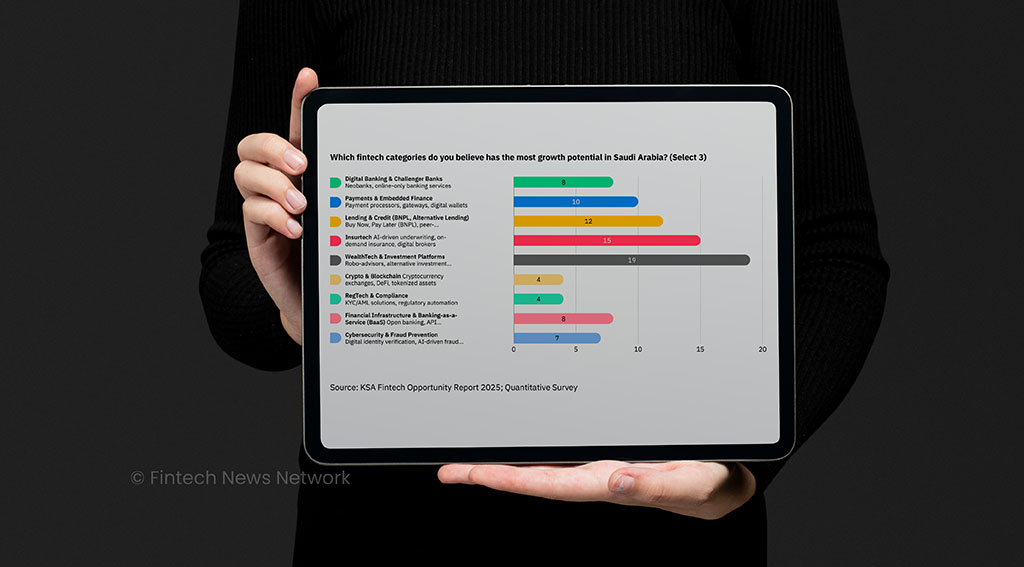
Looking ahead, industry stakeholders expect that the highest growth between 2025 and 2027 will be observed in wealthtech and investment, insurtech, and lending, according to a new survey by Swiss fintech venture capital (VC) firm Tenity.
Lending and alternative credit will be driven by unmet demand in the SME and corporate segments, which face an estimated US$80 billion funding gap. Wealthtech growth will be led by opportunities to serve the mass affluent with automated savings, holistic financial planning, and diversified access to global and local assets, including stocks, real estate, and private credit. Finally, insurtech will benefit from new entrants following the creation of the Insurance Authority (IA) in November 2023.

Featured image: Edited by Fintech News Middle East, based on image by rawpixel.com via Freepik
