



Agentic commerce is still emerging in the Middle East, yet interest is rising at a fast pace, according to research by Fast Company Middle East, Visa and Probity. Organizations are preparing to adopt new commerce tools, and most plan to spend up to US$1 million on AI within the next 24 months.
The new study, which polled senior leaders in retail, consumer products, travel and hospitality, and financial services across the United Arab Emirates (UAE), Egypt and Saudi Arabia, found that a small but notable 2.4% of Egyptian organizations have already deployed autonomous purchasing capabilities, including auto-reordering and autonomous purchases, across their organization, with an additional 32.2% looking at such solutions without fixed timeframes.
Enterprises in the UAE have progressed further, with 2.9% having fully implemented agentic AI, and 35.2% exploring these options without set schedules.


Despite low adoption rates, the study found that many organizations in these markets expect to adopt agentic commerce in the near future. In Egypt, 16.1% are preparing pilots within six months, while another 16.1% have outlined mid-term rollout plans.
In the UAE, 29.3% have set timelines, with 11.7% planning to launch pilots within six months, and 17.6% looking to implement the technology over the next one to three years.
These findings indicate that the market remains early but is advancing quickly.
Boosting revenue, customer loyalty and conversion
In the UAE and Egypt, organizations are pursuing agentic commerce for its potential advantages, especially gains in revenue, customer loyalty, and conversion.
Among respondents, revenue growth is the primary driver of agentic commerce adoption, cited by 26.6% of respondents in Egypt and 27.7% in the UAE. It’s followed by customer loyalty and retention at 20% for Egypt, and 33.3% for the UAE, and operational efficiency at 20% in Egypt and 11.1% in the UAE.
Market differentiation, at 13.3% in Egypt and 5.5% in the UAE, and customer acquisition, at 13.3% in Egypt, and 16.6% in the UAE, further reinforce the view that agentic capabilities are expected to create measurable commercial advantage.

UAE and Egyptian organizations are looking to tap into these opportunities, shifting their financial commitment to agentic commerce from experimentation to strategic intent. Most organizations have redirected or increased their budgets for new AI technologies, with more than a third in Egypt and the UAE allocating 1% to 4% of their annual budgets to AI initiatives.
A smaller yet notable share, 25.8% in Egypt and 26.4% in the UAE, allocates between 5% and 10% of annual budgets to AI. An even smaller group, 6.4% in Egypt and 8.8% in the UAE, invests more than 10%. This pattern suggests an early set of strategic movers beginning to pull ahead.

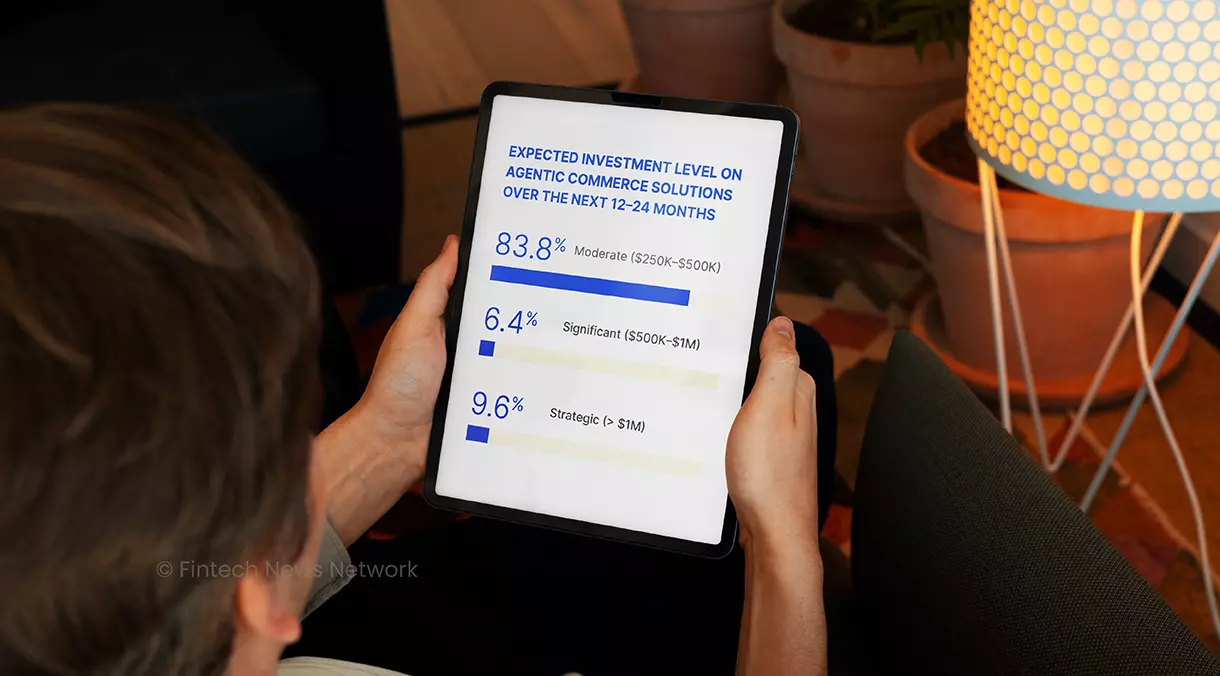
Looking ahead, expected investment in agentic commerce solutions over the next 12 to 24 months is substantial. In the UAE, especially, 17.6% plan to invest more than US$1 million, while 41.1% intend to spend between US$500,000 and US$1 million.
In Egypt, plans are more restrained. 9.6% plan to invest more than US$1 million over the next 12 to 24 months, and 6.4% plan to invest between US$500,000 and US$1 million. The majority, 83.8%, are looking at an investment in agentic commerce between US$250,000 and US$500,000.

Data security, unclear return as top obstacles
Despite strong commercial interest in agentic commerce, several obstacles are hindering the adoption of agentic commerce in these countries.
In particular, data privacy and security were cited as the leading concerns in the UAE and Egypt, at 24.5% and 19.3% respectively. This reflects the sensitivity that enterprises and their customers feel around how AI systems are handling personal and transactional data, suggesting a cautious approach to agentic systems.

Unclear return on investment (ROI) follows, cited by 17.2% of Egyptian and 13.7% of UAE organizations. This highlights how organizations in the region still struggle to define success metrics, quantify impact, and justify large-scale investments in autonomous systems.
Regulatory compliance concerns are close behind, cited by 15% for Egyptian firms, while UAE respondents mentioned concerns about fear of losing brand control or customer relationships at 8.8%, followed by dependence on external vendors at 7.8% These responses reflect leadership unease about ceding too much autonomy to AI systems or third-party platforms.

The release of the new study follows the launch of Visa’s Agentic Ready program in the UAE, addressing growing demand for AI-driven commerce in the country. The program aims to help financial institutions prepare for agentic commerce, allowing issuers to test and validate agent-initiated transactions within a controlled, production-grade environment during its initial phase.
Leading financial institutions in the UAE have already joined the program, including Abu Dhabi Commercial Bank (ADCB), Abu Dhabi Islamic Bank (ADIB), Al Ansari Exchange, Emirates Islamic, Emirates NBD, Mashreq, Tabby, Wio, and Ziina.
Featured image: Edited by Fintech News UAE, based on image by magnific via Magnific
