

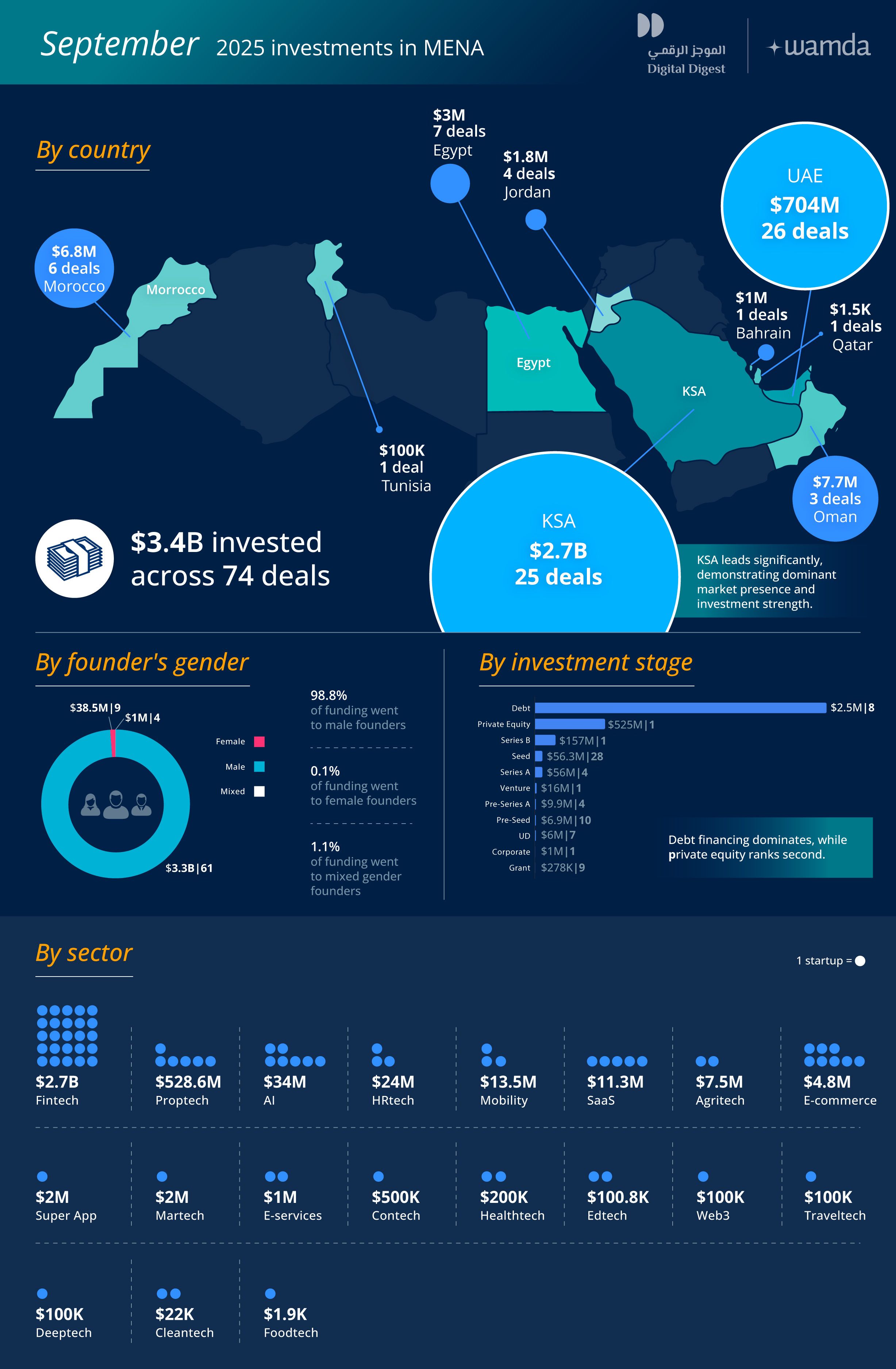
Startup investment across the Middle East and North Africa (MENA) reached a record high in September 2025, surging to US$3.5 billion across 74 deals, according to data from Wamda.
This marks a remarkable 914% month-on-month and 1105% year-on-year increase, representing a sharp rebound from August’s US$337.5 million.
Even after excluding the US$2.6 billion in debt financing, September still stands out as one of the region’s strongest months, with equity funding alone rising 147% month-on-month and 194% year-on-year.

Saudi Arabia led the region’s momentum, driven by several large-scale fintech transactions including Tamara’s US$2.4 billion debt facility, Hala’s US$157 million Series B, Lendo’s US$50 million debt raise, and Erad’s US$33 million debt financing.
The Kingdom accounted for 25 startups raising a combined US$2.7 billion, much of which was announced around Money20/20, the flagship fintech event where 15 deals were unveiled.
The UAE maintained a strong second place, with 26 startups collectively raising US$704.3 million, underscoring sustained investor confidence in Dubai and Abu Dhabi’s mature startup ecosystem.
Oman followed in third with three startups securing US$7.7 million, while six Moroccan startups raised US$6.8 million.
Egyptian startups, meanwhile, continued to face challenges, attracting only US$3.2 million across seven deals amid persistent macroeconomic headwinds and currency instability.
Fintech dominated investment activity, accounting for US$2.8 billion across 25 deals, largely driven by Saudi Arabia’s mega rounds.
Proptech followed with US$528.6 million, nearly all of which came from Property Finder’s US$525 million raise.
AI startups attracted US$34.3 million across seven transactions, while HR technology ventures raised a combined US$24.2 million.
Although the largest funding totals came from late-stage and debt deals, early-stage ventures represented the majority of activity, with 55 startups raising US$129.4 million.
By comparison, later-stage companies completed only four rounds but secured a total of US$699 million.
This highlights investors’ growing preference for more established ventures with proven scalability and market traction.
Startups operating under the business-to-business-to-consumer model recorded the highest funding for the first time, raising US$2.4 billion across 15 transactions.
Pure business-to-consumer startups followed with US$557.3 million across 23 deals, while business-to-business ventures attracted US$456.3 million from 36 transactions.
This reflects a wider regional trend towards hybrid business models that effectively serve both enterprise and consumer segments.
The gender funding gap, however, remained substantial.
Male-founded startups secured US$3.3 billion, while female-founded ventures raised only US$1.1 million across four deals.
The remainder went to mixed-gender founding teams, continuing a pattern seen throughout 2025, where women-led startups have yet to surpass the 5% funding threshold.
The third quarter of 2025 marked a period of breakout growth, with US$4.5 billion raised across 180 deals, representing a 523% quarter-on-quarter increase.
Year-to-date funding has now reached US$6.6 billion, exceeding most full-year totals since 2021.
Saudi Arabia continued to lead, attracting US$3.2 billion through 62 deals, followed by the UAE with US$1.2 billion across 59 deals.
Despite ongoing economic difficulties, Egypt ranked third with US$22.3 million, followed by Iraq with US$16.5 million and Morocco with US$14.5 million.
Fintech retained its position as the top-funded sector in the third quarter, with US$3 billion invested in 41 startups.
Proptech came second with US$684 million, buoyed by Property Finder’s round, while e-commerce ranked third with US$265 million across 14 deals.
Out of the 180 deals closed during the quarter, 134 were early-stage, raising US$538.3 million, while later-stage startups secured US$981.3 million from 17 transactions.
Twelve startups raised capital through debt instruments, indicating a growing acceptance of alternative financing structures.
Despite political tensions and the ongoing conflict in Gaza, 2025 has been a transformative year for MENA’s startup ecosystem.
The region is rapidly maturing into a magnet for local and international investors, with sovereign wealth funds, family offices, and global venture capital firms all increasing their exposure to emerging technology sectors.
If the current pace continues, 2025 could set a new all-time record for funding, reshaping the flow of capital and innovation across the Arab world.
Featured image credit: Wamda
