


Saudi Arabia’s fintech industry continued to grow in 2025, reaching 301 operating players at the end of the year, according to new research by Fintech Saudi, an initiative by the Saudi Central Bank (SAMA) to develop and support the country’s fintech ecosystem.
The figure represents a 30x increase in seven years from just 10 in 2028, and a 15% year-over-year (YoY) rise from 261 last year, underscoring increased adoption of digital financial services among both individuals and businesses, and progress towards the objectives by Saudi Arabia’s Vision 2030 plan.
The data were shared in a LinkedIn post by Sagar R Shah, a venture capitalist (VC) and advisor helping design and execute the strategy for Fintech Saudi. He also shared trends supporting this growth, including the shift towards cashless payments, growth in business digital lending, and an uptake in digital wealth management.

Digital payments
According to Shah, 80% of payments in Saudi Arabia are now digital, a figure corroborated by findings from the 2026 Visa Where Cash Hides report.
The study, conducted in 2025, found that 80% of payments in Saudi Arabia are now cashless. Only almost one in four Saudi consumers surveyed still use cash for everyday purchases, with this downward trend evident across all major categories, including eating out (-9%) and bills (-8%).

SME finance
In his LinkedIn post, Shah also highlights the rapid growth of SMEs, which is accelerating demand for SME-focused solutions, including business lending and fintech-based service solutions.
Though SMEs play a critical role in Saudi Arabia’s economy, contributing about 30% of GDP, they face severe credit constraints, receiving only about 10% of total credit supply, according to global management consulting and investment firm Redseer. This financing gap is estimated at SAR 500 billion (US$133 billion).

To address this gap, digital-first lenders are expanding rapidly, leveraging diverse funding models to enhance credit accessibility and integrating technologies to provide tailored financing options..
Redseer estimates that digitally enabled alternative lending players could potentially power over 20% of SME credit by 2030, a significant jump from a penetration of 2% of total SME credit in 2024.

Wealthtech
Another driver of fintech growth in Saudi Arabia is the rise of wealth, particularly among younger consumers. This trend is fueling demand for investment management and alternative investment fintech solutions, with robo-advisory platforms, in particular, demonstrating clear demand.
Assets under management (AUM) through robo-advisory platforms reached SAR 4.3 billion (US$1.2 billion) by H1 2025, with around 400,000 portfolios, according to Argaam, a Saudi financial news portal. These figures mark a 90% increase in AUM and a 54% increase in portfolios year-over-year (YoY).
In H1 2025, Saudi Arabia’s wealthtech market claimed 432,000 retail customers, and 18,490 qualified clients. With a total population of about 35 million, this suggests that robo-advisory platforms had fewer than 2% penetration of the adult population in that time, highlighting the sector’s tremendous growth potential.
Several startups are positioning themselves to capture this opportunity. Most recently, Vault, a digital private wealth platform from the United Arab Emirates (UAE), expanded its services into Saudi Arabia, targeting the country’s US$1 trillion in investable wealth and the modern affluent investors overlooked by private banks.
Banking incumbents are also entering the space. In October 2025, Jeel, powered by Riyad Bank, entered into a strategic partnership with Switzerland’s Synpulse to co-develop a digital wealth management platform for Saudi Arabia. The platform uses open APIs to connect banks, investment services, digital asset providers, and other financial tools into one ecosystem, and is being offering under a banking-as-a-service (BaaS) model.
The Saudi fintech ecosystem in late-2025
Over the past years, the growth of Saudi Arabia’s fintech sector has been strong, surpassing mid-term targets of 230 fintech companies operating in the country by the end of 2025.
In 2024, fintech companies in Saudi Arabia collectively secured SAR 905 million (US$241 million) in disclosed funding, bringing the total cumulative investment amount for the sector to SAR 7.9 billion (US$2.1 billion), 204% above the SAR 2.6 billion (US$693 million) target set for 2025.
The expansion of the Saudi fintech sector is fueling job creation. Employment in the industry stood at 11,046 direct jobs at the end of 2024, 76% above the 2025 target of 6,277 jobs.
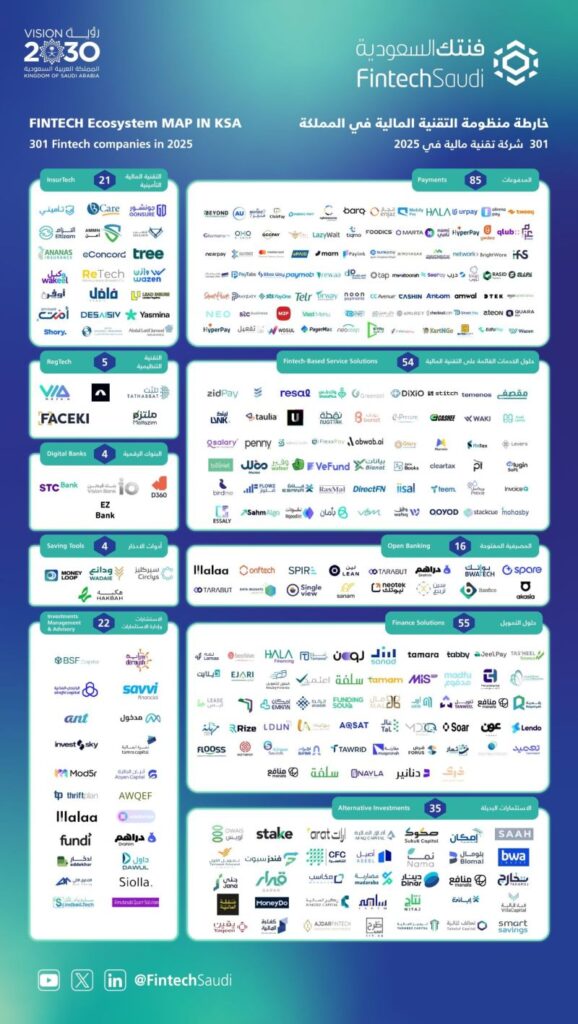
The latest data released by Fintech Saudi show that payments continued to dominate the Saudi fintech landscape in late-2025, accounting for more than 28.2% of all fintech companies operating domestically. Finance solutions followed, with a 18.3% share, overtaking fintech-based service solutions as the second biggest vertical. Alternative investments maintained the fourth position, with a 11.6% share.
In absolute terms, finance solutions saw the biggest jump between 2024 and 2025, with 19 new players, followed by insurtech with 7 companies, and payments with 6. Another notable mention is regtech, a brand new fintech vertical that had not been included in the previous years due to the limited number of dedicated players but which boasted 5 companies in late-2025.
Fintech Ecosystem Map in Saudi Arabia 2025:
Featured image: Edited by Fintech News UAE, based on image by Grinvalds via Magnific
