Get the hottest Fintech Middle East News once a month in your Inbox
Registering a company comes with a valid trade licence, named directors, and a stack of registration documents. From the company’s perspective, everything is in order to do business.
Yet, for a bank or payment provider deciding whether to accept it as a customer, that paperwork is just the starting point.
Who owns the company? Does someone else control its decisions? Does the business it conducts match the activities prescribed in its paperwork?
These questions are at the crux of know-your-business, or KYB, the process of verifying a company and understanding the risks of doing business with it. Answering them becomes harder when ownership crosses borders, and information is spread across different authorities.
For firms entering the UAE or expanding across the region, the otherwise familiar onboarding process for business verification in the Middle East may need considerable adjustment as compliance expectations become more sophisticated.
KYB has evolved from a documentation exercise into a business intelligence exercise. That shift now includes a growing focus on ultimate beneficial ownership (UBO) transparency, shared Adeel Mirza, the Head of the AML & KYC Unit at Al Masraf, a speaker in Sumsub’s webinar, Business Verification in the Middle East: Staying Compliant While Scaling.
This shift is justified, he added, because criminals have become more sophisticated at hiding behind complex corporate structures involving multiple jurisdiction-holding companies, including offshore entities.
Drawing heavily on UAE examples, the panelexplored why verification becomes complicated and what it takes to make that work as a business grows.
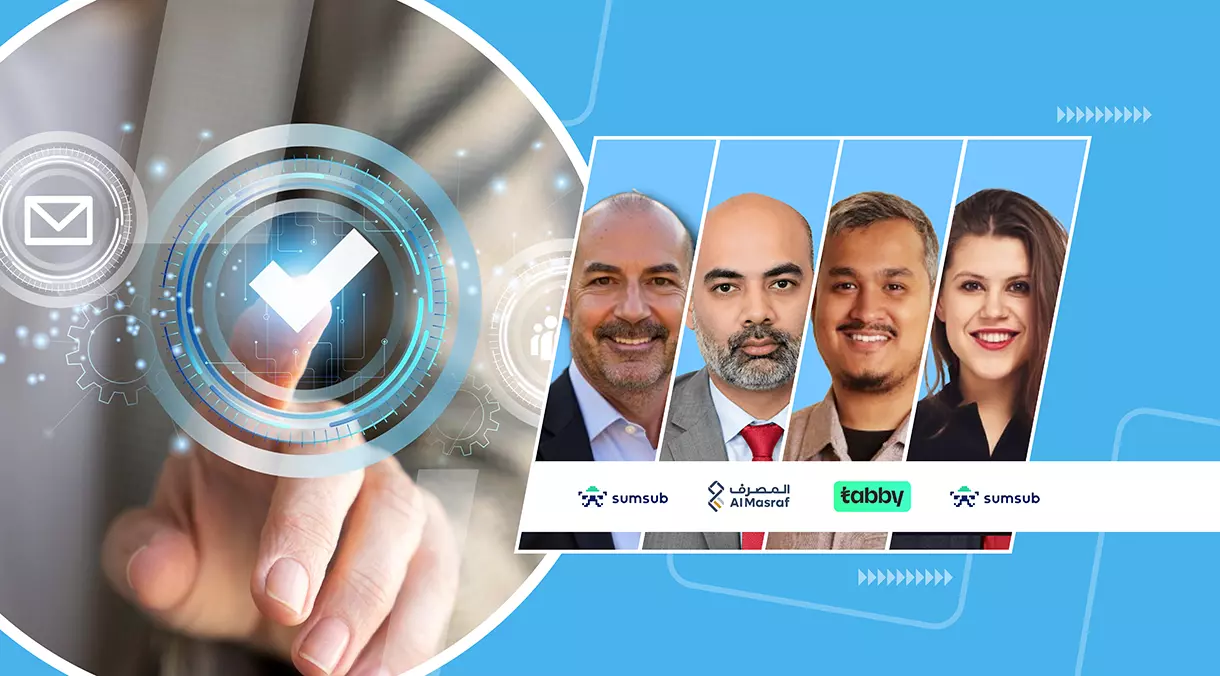
Moderated by Mark Bain, the Product GTM Lead – KYB at Sumsub, the discussion brought Adeel together with Syed Hassan, Head of Compliance & MLRO at Tabby, and Arina Rumyantseva, Senior Legal Counsel at Sumsub.
Why Beneficial Ownership Checks Cannot End at Onboarding
Verifying who ultimately owns a company requires attention throughout the customer relationship. Panellists described the growing pressure on institutions to keep owner information current and act when discrepancies emerge.
Arina Rumyantseva, Senior Legal Counsel at Sumsub, pointed to Europe’s evolving requirements as an example. The EU’s Anti-Money Laundering Regulation (AMLR) introduced a requirement for institutions to proactively report discrepancies found between the due diligence process and information held in central registers. She added,
Arina Rumyantseva
“The regulatory framework is becoming more interesting, and we’re curious to see how different regulators in different regions are trying to cope with the problem where, for instance, beneficial owners are still not properly checked.”
In the UAE, licensing authorities are making ownership information more accessible, Adeel added.
Adeel Mirza
“When they (licensing authorities) issue a trade licence to a company, they include the UBO details as part of the licence. So as a bank or a financial institution, we can identify who the UBOs are now. It’s becoming more advanced in the UAE, especially.”
Adeel delved further, saying that the alignment with international standards across the region is now very strong, particularly after the Financial Action Task Force (FATF) evaluation and the UAE’s time on the FATF grey list, which it has since exited.
“The focus has shifted from drafting framework to demonstrating effectiveness in implementation, and that is a focus of the examiners also,” he said. “Examiners are asking questions not about the framework, but how effectively they have been implemented.”
Show us how you are doing it. Show us the results. What methods have you used, and how have you achieved the target?
The good news is that most jurisdictions in the region now broadly align with FATF standards, including core expectations around risk-based AML frameworks, beneficial ownership, customer due diligence, transparency, sanctions compliance, and suspicious transaction reporting. And that momentum is accelerating.
“Over the last few years, we have seen a clear acceleration in strengthening these areas, particularly after mutual evaluation cycles and increased international scrutiny,” Adeel emphasised.
KYB Becomes Tougher Once the Business Crosses Borders
Middle Eastern companies expanding internationally start from a high KYB baseline at home. Syed Hassan, Head of Compliance & MLRO at Tabby, said that the Central Bank of the UAE (CBUAE) expects firms to understand a customer’s geographies, counterparties, products, channels, and transaction purpose.
Syed Hassan
“KYB standards are really high, at least from a CBUAE and UAE perspective. Middle Eastern companies, especially payment firms, fintechs, exchanges, and remittance providers, often transact across high-growth corridors, and these can see higher sanctions, trade-based money-laundering, and terrorist financing risks,” Syed shared.
Adeel chimed in. He shared that the UAE and Oman were the biggest trade hubs in the Middle East, and that it has now become clearer that very few companies in the region are purely domestic.
Even mid-sized firms are now part of a global supply chain.
“They may have incorporated in one jurisdiction, banked in another one, have shareholders in a third country, and trade with counterparties spread across multiple regions. Complying with regulatory governance in one country is not sufficient anymore,” Adeel explained.
In Adeel’s reading, banks have to look at the footprints of these entities, too. However, the data behind those checks often comes from fragmented data sources, demanding that proper policies and processes be in place.
“You’ve got to be very clear on what those requirements are, and operationally you’ve got to be sound in implementing that,” Syed added.
One critical juncture towards that direction, Syed pointed out, was the e-KYC platform that the CBUAE announced in April, with Norbloc AB as its technology partner. As he understands it, the platform uses distributed ledger technology and will allow financial institutions to reuse due diligence data.
“That will really add a lot of benefit for FIs (financial institutions) in the country in terms of compliance operations and cost. On the customer side, being able to reuse some of the data is hugely beneficial from a customer experience perspective,” Syed said.
The platform is expected to roll out to all financial institutions, though no clear timeline has been shared yet. Syed expects attention to shift towards ongoing monitoring and risk profile monitoring as a result.
“What it reduces is CDD data collection, but the rest of the cycle still exists,” he explained.
Automating KYB Does Not Remove Accountability
With regulations moving swiftly, the panel closed in on what a robust KYB framework in the region should look like. The challenge ahead is scaling KYB without weakening it, and automation is central to doing so, especially as the volume and complexity of data continue to grow.
“Automation is not about removing humans from the process,” Adeel said. “It’s about removing inefficiencies so that humans can focus on higher-value, judgement-based decisions. Automation does not replace the accountability part. Regulators still expect the institution to understand and justify their decision. Even in a highly automated environment, there must always be explainability and human oversight.”
He recalled asking a vendor of AI transaction monitoring what the institution’s defence would be beforeregulators if the system missed an alert.
The vendor had no answer.
Ultimately, the customer that clears onboarding today may look quite different a year from now. Beneficial owners can change, counterparties can shift, and businesses can move into new markets.
The test for institutions is to notice when a business veers from its original profile and show regulators a clear trail when asked, because the accountability almost always rests with them.